Code Green: Thirty-two Minutes
by admin on January 16, 2012 at 11:09 am
Raffle to support DGR: name a character in our novel
by admin on January 13, 2012 at 12:30 pmDeep Green Resistance, the organization inspired by the book of the same name, is holding a fundraising raffle.
One of the items offered to winners is to name a character of the upcoming novel co-written by Derrick Jensen and myself. The Knitting Circle Rapist Annihilation Squad will be published in 2012 by Flashpoint/PM Press. It’s a comedy about a group of women who kill rapists (in the words of one reader: “Andrea Dworkin meets Monty Python”).
Enter this raffle for the unique opportunity to choose the last name for one of the smaller characters in the book (provided the name doesn’t distract from the book. In the words of Derrick Jensen, “Moonbeam or Cannibal or Gesundheit” would not be appropriate!)
You will also receive a free copy of the book when it is released.
Here’s the page where you can buy tickets: http://deepgreenresistance.org/dinnerwithderrick/
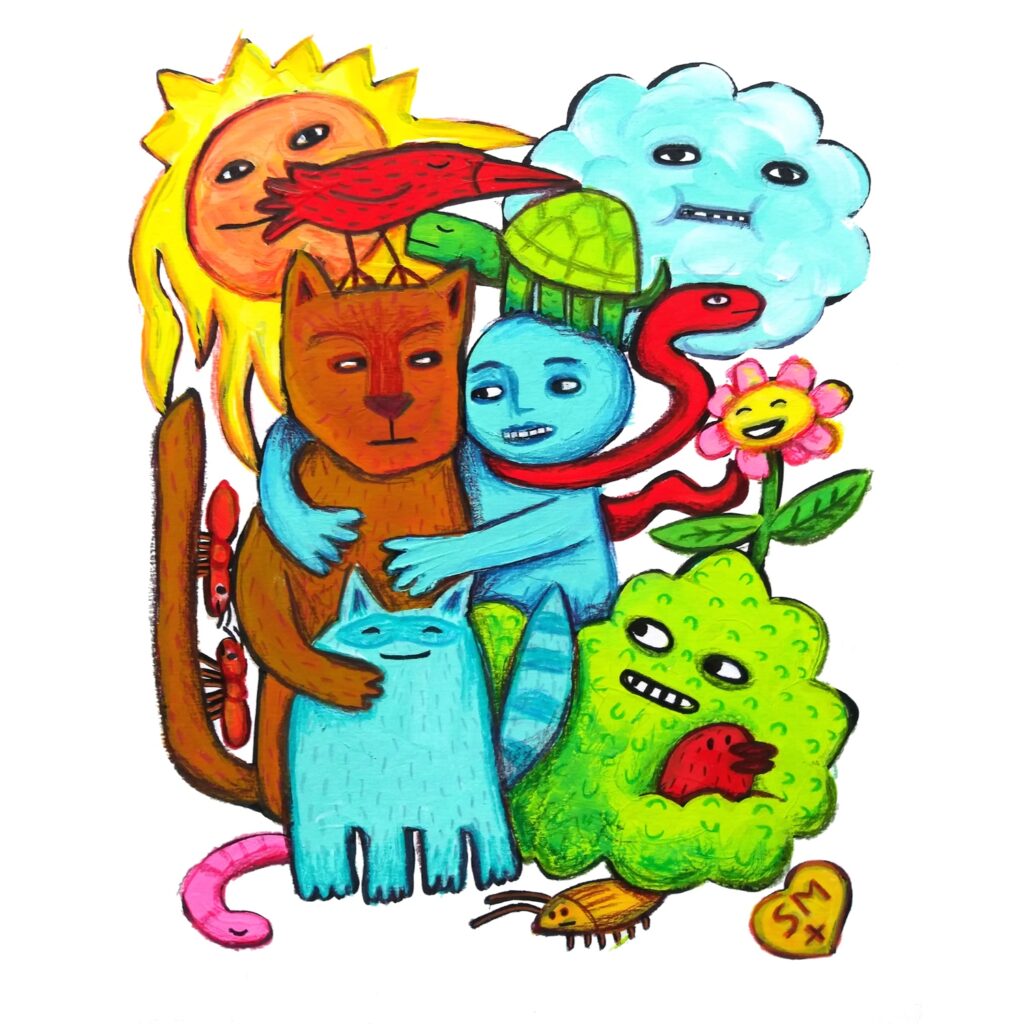
Here’s the cover:
Embroidered patch available: The Knitting Circle Rapist Annihilation Squad
by admin on January 13, 2012 at 12:24 pm
Patch – “The Knitting Circle Rapist Annihilation Squad”
This embroidered patch is on the cover of a novel I co-wrote with Derrick Jensen (due out September 2012 from PM Press/Flashpoint). It can be either ironed or sewn on. Measurements: 3.5″ x 3″.
$6 each; $25 for each multiple of five – FREE shipping in US.
I drew a logo for Deep Green Philly.
Here’s an interview I did with them back in August:
http://www.deepgreenphilly.com/?p=385
My comics-journalism project on the occupy protests is mentioned in Der Taggespiegel (Berlin) (1/3 issue), with an image included:
http://www.tagesspiegel.de/kultur/comics/politik-im-comic-der-geist-der-bewegung/6014790.html
Excerpt:
So bieten die unterschiedlichen Beiträge vor allem sehr persönliche Blicke auf die Bewegung und ihre Entwicklung und portraitieren diese mit all ihren Widersprüchen. Stephanie McMillans „The Beginning of the American Fall“ (Teil 1 hier, Teil 2 hier) zeigt zum Beispiel, wie die beiden zunächst unabhängig entstandenen Bewegungen „Stop the Machine“ und der Ableger der Occupy-Bewegung in Washington D.C. sich immer mehr annäherten, bis sie schließlich ineinander aufgingen. Die seit 1992 als politische Cartoonistin aktive Zeichnerin führt nicht nur unterschiedliche Charaktere vor, sondern zeigt auch deren Zusammenspiel und damit die organisatorischen und konzeptionellen Diskussionen und Planungen im Hintergrund der Occupy-Bewegung. So wird deutlich, dass dort viele verschiedene Interessen aufeinander treffen und der nach außen präsentierte Zusammenhalt der Aktivisten nicht immer selbstverständlich ist.
Code Green: Tyranny of Unanimity
by admin on January 9, 2012 at 1:07 pm
I’m thinking about the past year and making plans for this one.
Some highlights of 2011:
* I attended “Stop the Machine” for a week in Washington, DC and drew a 10-page comics-journalism piece about it: http://www.cartoonmovement.com/comic/20
* In November, I spoke at Earth at Risk, an all-day conference in Berkeley, with Derrick Jensen, Arundhati Roy, Thomas Linzey, Waziyatawin, Aric McBay, and Lierre Keith: http://www.earthatrisk.net/. A DVD and a book of this event will be released in the coming months.
* I spoke at various events including Left Forum and Spring College Media Convention (NYC), Occupy Miami, and the Society of Environmental Journalists conference (where I also helped organize a rally outside with dozens of local environmentalist organizations).
* The anti-capitalist/anti-imperialist collective that I work with, One Struggle, continued to grow, hold discussions, and participate in local political life. Here’s the website: http://onestrugglesouthflorida.wordpress.com/
* My editorial cartoon, “Code Green,” earned a Sigma Delta Chi Award from the Society of Professional Journalists.
This year so far I plan to speak again at Left Forum and other venues. I have a couple books in the works, including “The Knitting Circle Rapist Annihilation Squad,” a novel (genre: political comedy) co-written with Derrick Jensen, to be out in September. The current story for “Minimum Security” is all plotted out to finish this summer, after which the format will change. I’m working on a short film with the working title “Capitalism Must Die.”
Oh yeah, and the economy will collapse and we’ll be further along in the process of revolution. Lots to do!
Code Green: Wants a Higher Bribe
by admin on December 19, 2011 at 10:56 am
Here’s an interview I did for Huffington Post: http://www.huffingtonpost.com/2011/12/09/stephanie-mcmillan-occupy-comic_n_1137636.html?ref=dc
HuffPost: Are you coming back to D.C. to do a part three of American Fall?
McMillan: I don’t have specific plans to go back to D.C., but since then I’ve had a chance to briefly visit Occupy Oakland and Occupy San Francisco. I’d love to visit Occupy Wall Street and a few other places. In South Florida, I regularly work with an anti-capitalist/anti-imperialist collective called One Struggle, and we’ve been active at both Occupy Fort Lauderdale and Occupy Miami.
HuffPost: Are you making a cartoon about Occupy Fort Lauderdale?
McMillan: I haven’t yet drawn cartoons about OFtL, but I probably will! I think comics are a very appealing way to document the movement, highlight important details, and explore some of its contradictions.
HuffPost: Are you getting Occupy snowbirds?
McMillan: I don’t personally know of any snowbirds staying at Occupy Fort Lauderdale, but I’ve heard that there are people at Occupy Miami who have come from encampments up north to spend the winter down here.
HuffPost: I love that your cartoons of the Occupation are so affectionate and at the same time you aren’t afraid to poke fun or show and examine flaws. What do people inside the Occupation think of the cartoons?
McMillan: Thank you! I’ve received very nice responses and feedback. People appreciate that I’ve brought out the essence of some of the issues people are wrestling with. Many participants find the movement very contradictory, and have mixed feelings about it — one minute we’re weeping with joy, the next minute grinding our teeth in annoyance. It’s a rollercoaster of love.
HuffPost: Do you have any specific demands? (I have to ask.)
McMillan: I don’t have demands because I don’t recognize the legitimacy of those in power (so why would I demand anything from them?), and I don’t believe that this system can be reformed. But I absolutely have goals: a sustainable way of life free of class divisions and all other forms of domination.
The whole thing is here at Cartoon Movement: http://www.cartoonmovement.com/comic/25. Both parts together are 10 pages total.
Page 1:
Earth at Risk (November 13, Berkeley) was amazing! It was an honor to share the stage with such brilliant people: Derrick Jensen, Aric McBay, Lierre Keith, Arundhati Roy, Waziyatawin, and Thomas Linzey.
Being able to visit Occupy Oakland and Occupy San Francisco was also wonderful.
I had presented part of this talk (the part about why Capitalism Must Die) at Occupy Miami the week before. That went well too.
Here’s a story in the Washington Post blog “Comic Riffs” — http://www.washingtonpost.com/blogs/comic-riffs/post/occupy-comics-cartoon-movement-journalists-sketch-a-multi-city-composite/2011/11/15/gIQAxRvtPN_blog.html
Excerpt:
“When I heard about ‘Stop the Machine,’ it seemed to have more potential than traditional protests, because they declared that they weren’t going to leave until their demands were met,” McMillan tells Comic Riffs of one of the D.C. protests. “It promised a higher level of determination and militancy than the usual actions — so I really wanted to go and be a part of it.
“Meanwhile, during the period before ‘Stop the Machine’ was due to begin, Occupy Wall Street emerged, and many other encampments in its wake,” McMillan continues. “It seemed that the American people were waking up and deciding that they were no longer prepared to silently tolerate the many injustices that those in power have been perpetrating on the people and the planet.”
The Amsterdam-based Cartoon Movement has commissioned a ten-page piece about the Occupy protests. The first five pages can be seen here: http://www.cartoonmovement.com/comic/20. The second part will be posted in early December.
Here’s page one:


For more weekly Code Green editorial cartoons, please see stephaniemcmillan.org/codegreen/
The people are in motion! We’re standing up to join a global movement, what may become a global revolution.
This is beautiful! I’ve been waiting and working all my life to see this. We’re all here because in general we want the same things: a new society based on fairness, sustainability, healthy communities, a living planet. An end to domination and oppression of all forms.
What stands in our way? Is it greedy corporations that have grown to big and gone too far? It’s those, but it goes deeper than that. Profit. Profit is the problem. And a whole social/cultural/economic/political system based on accumulating profit, through the extraction of natural resources and the exploitation of labor.
We have an enemy. I’ll go ahead and name it: global capitalism.
Capitalism is not a thing, but a process: the conversion of life into commodities into toxic waste.
It’s also a social relation, where a small minority owns and controls our means of subsistence and uses this to dominate and exploit the majority of people and the world. Those in power start out by seizing land and destroying traditional land-based and indigenous communities. They push people into labor camps (commonly known as cities), and make them work for food and shelter. Would anyone consent to work in a factory or mine if they had any other way to survive? Would you? I wouldn’t.
Capitalism is based on constant expansion, on ever-increasing rates of private accumulation. This means it’s structurally unreformable. The nicest capitalist in the world might want to change that, but wouldn’t be able to. They must make profit or go out of business.
Global capitalism is in deep crisis. It’s played out. Many expect it to collapse. But the truth is, it won’t. It’s dynamic and adaptable. It could morph into fascism or neo-feudalism. But it will use up everything and keep going until all life on the planet is extinguished.
I don’t know about you, but for me that’s too late.
We must eliminate it. It’s our responsibility. We may be the last generation with the opportunity to do so.
With this action, with this movement, I’m starting to believe it’s possible!
I hope to see this grow into a radical mass movement that can unite all who can be united to fight the system, our common enemy. A diverse, non-sectarian movement, mutually supportive, and above all visionary and fearless.
We don’t know what’s going to happen or what this will become. But we have to keep it going, keep moving hand-in-hand to wherever the demands of our situation may lead us.
Sure, we’re chaotic, flawed, unpredictable. This may not be exactly what each of us wants or thinks we need. But the important thing is that we’re MOVING. We’ve woken up. We’re challenging the system.
Capitalists, we’re coming for you!
Imperialists and war-mongers, we’re coming for you!
Exploiters and oppressors, we’re coming for you!
Ecocidal maniacs and corporate bloodsuckers, we’re coming for you!
We’ll fight you, and we’ll fight you, and we’ll make mistakes along the way, and we’ll falter. But we’ll keep getting up and we’ll fight again, and fight again, and one day we are going to win.

For more weekly Code Green editorial cartoons, please see stephaniemcmillan.org/codegreen/
I’ve been in Washington, DC since last Thursday at the October 2011 action in Freedom Plaza. Here’s a photo of me and Bunnista at the White House:
And here’s a video of a speech I gave on Saturday:
Ted Rall and I put together a quick comix pamphlet called “Occu-Pie Comix.” Someone attached it to their tent:
Here’s a pdf of the front and back covers and the interior.
I’ll be in DC starting Thursday, participating in the “Stop the Machine” protest. Hope to see you there!

For more weekly Code Green editorial cartoons, please see stephaniemcmillan.org/codegreen/

For more weekly Code Green editorial cartoons, please see stephaniemcmillan.org/codegreen/

For more weekly Code Green editorial cartoons, please see stephaniemcmillan.org/codegreen/

For more weekly Code Green editorial cartoons, please see stephaniemcmillan.org/codegreen/

For more weekly Code Green editorial cartoons, please see stephaniemcmillan.org/codegreen/
From Sun-Sentinel article, “Nuke program wrong move, wrong place” by Philip Stoddard, Mayor of South Miami:
Under our American capitalist model, corporations issue bonds to raise money for new projects. But here in Florida, our Legislature allows a publicly traded utility to take our money, never repay the principal and charge us 10 percent interest on whatever it builds with our dollars. So long as a “regulated” utility can claim to be planning a new nuclear reactor, it can bypass Wall Street and take the money directly from ratepayers like us ahead of time.
This amazing scam is perfectly legal under Florida Statute 366.93, known as the Early Cost Recovery. An electric utility can take our money up front for any and all of the following:
“All capital investments, including rate of return, any applicable taxes, and all expenses, including operation and maintenance expenses, related to or resulting from the siting, licensing, design, construction or operation of the nuclear power plant, including new, expanded or relocated electrical transmission lines or facilities of any size that are necessary thereto.”
The full article is here: http://www.sun-sentinel.com/news/outlook/fl-fpl-nuclear-energy-mistake-stoddard-07-20110830,0,4372245.story

For more weekly Code Green editorial cartoons, please see stephaniemcmillan.org/codegreen/
The capitalist system sets up a false jobs vs. environment conflict, that serves the system on both sides. If people’s land wasn’t stolen and destroyed, they wouldn’t be able to be forced into a position of dependency and into the labor force in the first place.
Here’s an interesting article by a labor leader about why he opposes the Tar Sands pipeline. Though he’s very much part of the establishment unions, he seems to be honestly grappling with the false conflict between labor and the environment that has been set up by the ruling class.
I don’t see things the same way he does (like his advocacy of “green jobs” within a continued framework of capitalism, or participating in a protest of orchestrated arrests that appeals to Obama), but he makes some good points and, I think, eloquently expresses the real anguish of the worker trapped in a bind — of balancing the immediate need to feed one’s family while realizing that the only options we’re offered for doing so are destroying their future.
http://www.truth-out.org/why-im-marching-bill-mckibben-protest-keystone-pipeline/1314112061
Anarchie Verte has posted more translations of Minimum Security comics, here: http://anarchieverte.ch40s.net/2011/08/fin-de-la-serie-sabotages/
18 of them, starting with this one:


For more weekly Code Green editorial cartoons, please see stephaniemcmillan.org/codegreen/
It’s hard to find anything to eat anymore that isn’t going to kill us. Recently I wondered: should I eat hormone-infused US-made cheese, or radioactive European cheese?
Hm.
Decided on a handful of raw almonds (irradiated or fumigated with proylene oxide) instead.
Here’s an article about my work in the Transylvanian online newspaper Transindex: http://think.transindex.ro/?p=9198

For more weekly Code Green editorial cartoons, please see stephaniemcmillan.org/codegreen/
Here’s an audio interview with Ron Whyte of Deep Green Philly. We discussed the role of art in resistance movements, the evils of Monsanto, and more.
Here’s an interview I did with SPJ’s “Quill” magazine.
* * *
Thursday, August 04, 2011
Ten with Stephanie McMillan
By Scott Leadingham
To call Stephanie McMillan a cartoonist is like calling Paul McCartney a musician. It’s accurate in all meanings of the word. But leaving it at just cartoonist (even adding “editorial” as a descriptor) comes up short. She might rightly be described as a social activist and agitator, one whose pointed commentary and analysis are conveyed most visibly through pictures and their associated dialogue bubbles. Her incisive work caught the attention of the Sigma Delta Chi Awards judges, who recognized her excellence for the recurring syndicated cartoon “Code Green,” about environmental issues. The Fort Lauderdale, Fla., native studied film animation at New York University’s Tisch School of the Arts. Next year will mark her 20th drawing regular cartoons for newspapers.
What was your first reaction to winning a Sigma Delta Chi Award?
I was thrilled, of course. It means a great deal to me to be recognized by such a widely respected organization. I’m honored to be grouped with journalists who have done such great and important work. Beyond the personal level, I’m pleased that they chose cartoons of a non-traditional style and by a woman, both of which rarely win major awards.
Your cartoons focus — rather bitingly — on “green” or environmental topics. What’s the inspiration behind that theme?
Though my focus was, for a long time, on social justice (which I still care deeply about), several years ago I became very alarmed about the increasing speed and scope of the destruction of the planet. It became clear to me that this problem supersedes all others. Without a living Earth, nothing else matters. Our lives depend on it. I decided to dedicate myself and my work to confronting this reality, in the hope that I could make some difference.
Your website, where you have all of your “Code Green” samples, has a built-in German page, too. What’s the story there?
Last year I visited relatives in Germany, and they helped me translate my cartoons and send them to German newspapers. Not much came of the attempt, but I do have some regular readers in Germany, so I keep them on the website in their honor.
I read that one of your big inspirations was “Peanuts.” Any other artistic inspirations or “heroes” from the editorial cartooning field?
Yes, I’m very partial to the cartoons that have traditionally been run in the alternative weekly papers, such as Matt Groening, Lynda Barry, Ted Rall and others. When I lived in New York, I picked up the Village Voice religiously, just for the cartoons. I loved “Stan Mack’s Real Life Funnies,” “Washingtoon” by Mark Stamaty, and Ben Katchor’s “Julius Knipl, Real Estate Photographer.”
Correct me if I’m wrong, but it seems like there’s a big gender gap in your field (not just cartooning, but more narrowly editorial cartooning for news outlets). Why do you think that is?
Part of it is that there aren’t very many cartoonist staff positions at newspapers, and the few that exist are often held for life. Some cartoonists have held these positions since the days when certain types of work were considered “men’s jobs,” and women were not considered serious opinion-makers. Times have changed, but these jobs come up so infrequently that many women, noting their slim chances, don’t even bother to aspire to them.
Also, women are often still, for some reason, expected to focus on “women’s issues.” These consist, in some minds, of children, dating and dieting, not world affairs and current events. I would also like to know why they don’t hire more female cartoonists. That said, I know many wonderful (male and female) editors who have valued my work and have never made me feel marginalized in the slightest.
The third factor is our social conditioning. Men and women are expected to behave differently. Sharply critical statements, when uttered by men, are considered bold and assertive; but the same statements uttered by women are often labeled “shrill.”
Did you ever think being female would be a stumbling point for you when trying to “break in”?
I don’t think of being a woman as my main obstacle; succeeding as a cartoonist of any gender is against great odds. However, it is a factor. People say that they would like to see more women cartoonists, but then do not give us work. I like challenges, but it’s a difficult career path, and occasionally I worry that I may have to quit.
What about considering another route in media/journalism? Did you ever say, “Hey, I’d really like to be a reporter or producer”?
I love writing, and I’ve written many essays and book reviews and so on. I co-wrote a novel recently that will be out next year. My motive in drawing, writing and everything else is to further the larger aim of improving our situation in the world. For me, being a cartoonist isn’t the point; the point is to assert opinions about politics and social issues and so on, in ways that might have influence. I do love cartoons, but I would express myself in whatever form or venue where I could build a loyal audience. I think my most valuable skill is honing down an argument to its essence. This is very suited to cartoons, which must be instantly understandable.
You also write another strip called “Minimum Security,” which is much different than “Code Green.” What’s the inspiration behind that?
“Minimum Security” started out as an editorial cartoon but changed to a daily comic strip when it was acquired by United Media. It’s currently a long-form narrative about a group of friends trying various strategies and tactics to save the planet from corporate overlords. It’s a thought experiment. I take readers through various activist schemes and personal crises, and no one in real life gets hurt.
Take us through your typical day or at least from concept to completed product. How does that creative process work for you?
I spend about two hours every morning reading, catching up on current events as well as digging into deeper political analysis. I create the cartoons on a weekly cycle. Each Monday and Tuesday, I write scripts for one “Code Green” cartoon and five “Minimum Security” comic strips. Sometimes this is a lengthy and difficult process; but when I’m lucky the ideas come quickly. If I have extra time, I spend the rest of the days marketing and seeking clients. On Wednesdays and Thursdays I usually do other freelance work, and then Fridays and Saturdays I draw all the cartoons at once. On Sundays, I color them. I post and send them out to all the places they have to go on Sunday nights and Mondays; this alone takes several hours. Then the cycle begins again.
OK, the inevitable “advice” question. To those wanting to get into cartooning ― maybe the young journalism student out there who’s also a kick-butt artist with a knack for humor ― what do you say?
If you love it, and are prepared for a long and difficult road, then you should do it. There are a few quick successes, but for most, it takes commitment, persistence and stubbornness beyond all reason. If you’re the kind of person who won’t give up, and you can work hard and long hours, and you’re willing to sacrifice a great deal to do what you love and believe in, then you can make it. If you want to, you should try. Life is too short, too precious to settle for mediocrity, whether it’s in love or your profession or anything else.

For more weekly Code Green editorial cartoons, please see stephaniemcmillan.org/codegreen/

For more weekly Code Green editorial cartoons, please see stephaniemcmillan.org/codegreen/
In 2005, Hurricane Wilma crossed over South Florida. The destruction was substantial. A telephone/electric pole lay across my back yard, its transformer trailing wires. Most of a large tree had come down on my neighbor’s roof. Branches were everywhere. Bits of the corrugated fiberglass roof of a plant nursery littered the ground ten blocks away. The electricity stayed off for eleven days. The municipal water supply stayed off for three.
I still had to go to work. As I made my way around town on my bike in the following days, I saw a difference in the way the people of my neighborhood and the people of the next neighborhood over handled their respective difficulties.
In the best of times, my neighborhood – mostly populated by short-term renters who were only around when not out working on boats for weeks or months on end – enjoyed little-to-no social cohesion. Few people even recognized each other as neighbors. Each was generally on his or her own.
Residents made a rather pathetic scene as they used soda cans to scoop water from street puddles into plastic kitchen garbage bins, to use for flushing toilets. The general mood was testy. It was hot and humid. Everyone was sweaty, with no showering in the foreseeable future, and food was rapidly spoiling. A fight broke out at a nearby gas station over ice.
Did I mention that it was hot? It was hot. The air was heavy with moisture steaming from the soaked ground. And of course there was no salvation to be had from fans or air conditioners. So everyone opened their windows wide and prayed for a breeze.
The first night, the guy who lived behind me ran a generator. Lying on my bed in the dark (bored to tears, no light to read by), I waited for the roar to end. By 2 a.m., I realized it wasn’t going to stop. All hope of sleep died in a spasm of frustrated rage.
The next day I saw him cleaning up his yard. I didn’t want to start the conversation by accusing him of self-centered jerkitude – I assumed the best of intentions. “I noticed your generator was on all night. Do you have some sort of medication you need to keep cold, or…?”
“Nah, I wanted to watch the game,” he replied.
“Well,” I ventured, “It’s very noisy, and I’m sure I’m not the only person around here who can’t sleep when it’s running. Would you mind turning it off at a reasonable time? Midnight, say? I have to get up early in the mornings to go to work.”
He glared. He turned away. His generator ran all night, every night, for the next ten nights.
In response, I could do nothing but seethe. There was no law against running generators. He was bigger than me, and he didn’t care about the needs of anyone else. (I fantasized at great length about smashing his generator with rocks, a bat, or a barrage of bullets, but because I had complained he would have known instantly who’d done it, and was I prepared to go to war with him if he came for revenge? I decided not.)
* * *
Contrast this with the neighborhood next to mine. Long-time residents with families. People knew one another by sight, at least, probably because they were always out walking their dogs or jogging.
By the second morning, as I passed through, I saw a small group of people talking in the park. I didn’t stop.
On the third day, I saw them again. The group was larger than the day before. They had a sign board set up. One man was gesturing toward it, and announcing something to the others. I stopped to listen.
They were having a meeting. They were working things out.
The man told his neighbors that the sign board was there for them to exchange messages with one another in the absence of phone service. They could post requests for things they needed, and those who wanted to help could do so. They could combine forays to the store to save gas. They could share food that would otherwise spoil. Each morning, they were to have a meeting to address their concerns.
One person said, “There’s someone on my block who runs a generator all night.”
Several people grumbled – they too had been disturbed by this. One declared, “We have to make a rule: unless it’s an emergency, no generators after 10 p.m.”
So they made a rule. A small committee formed instantly, volunteering to have a chat with the offender. The neighborhood had spoken.
* * *
I learned several lessons from this:
1) A group of people can meet each other’s needs together much more efficiently than individuals can meet their own needs separately.
2) Cranky self-centered jerks respond better to social pressure than to individual complaints.
3) For a group of people to be organized in a common effort, it takes just one person to decide to take responsibility for initiating it.
4) If no one does that, it won’t happen by itself.
5) Once that first person steps up, then it’s not that hard to persuade others to cooperate in a mutually beneficial endeavor. They want to do it.
6) It’s good to get to know your neighbors before crisis hits.
Why are there so many small groups on the Left?
by admin on May 21, 2011 at 9:41 am
People coming into political motion often take a look at the field of activity on the Left and shake their heads. “Why are there so many small, disunited groups?” they ask. “Why can’t they get along and work together?”
Line differences within groups have come from practice, or responses to the practice of others. At certain points in history the line differences are worth splitting up over, because they lead to qualitatively different further practice. Sections of groups part ways because each believes their way is correct and the other way is going to lead to failure.
But most of the sects that exist today emerged out of a previous era of struggle, and their differences are rooted in the past. Many of the questions that were once crucial and defining, are irrelevant to people coming into political life today. They don’t want to (and shouldn’t have to) go through a long list of historical verdicts and ideological points that they have to agree with to join a group. It’s too hard – what if they agree on 60% or 80% but can’t come to agreement on the rest? Then they’d either have to suppress their differences and join anyway, or would have to form another sect with that minor difference as the distinction between them.
Instead, now people are seeking to organize new groups from the ground up, with people who generally agree on current issues and basic goals, and are willing to figure out the rest as needed.
This is why, I think, there are so many small collectives starting everywhere. People coming into political life for the first time, or getting back into it after a long break, or coming out of some of these sects, are figuring out what they think about our current conditions. They are putting aside the impulse to form verdicts on historical questions, and starting over.
This doesn’t mean they don’t learn from previous struggles. People are studying — not to just appropriate a finished system of thought in the abstract, but creatively, in order to see how others approached similar problems in different times and places, and to find solutions and methods that can help today. It’s great that they’re starting fresh, because when people define their own theories, ideologies and political lines, then they’re rooted in their own experiences, observations, and emotions. The ideas become an integral part of the people, who then become an integral part of a movement, in a way that can’t happen if they come in and rely solely on the previous work of others. The creative process of articulating beliefs and forming principles, incorporating what makes sense from past lessons, and testing what parts of the new mix works and what doesn’t, is part of the liveliness of an emerging movement.
The people coming into motion today don’t see the need to divide themselves along the same lines, or down to the same level of detail as those who have been around a long time — though divisions are still there based on very broad historical verdicts and deep scars. For example, in recent decades I haven’t noticed anyone refuse to work with someone who has a different opinion on Enver Hoxha’s break with Mao. Most people don’t know or care about it. On the other hand, many anarchists still feel betrayed by communists because of the Spanish Civil War and other blunders and won’t even consider working with them, or will only with extreme wariness and some expression of regret on the part of the reds.
Splits form along new lines: anarchists are splitting over being vegan or omnivore. Deep green environmentalists demarcate themselves from technotopians. Anti-war activists congeal into mutually frosty camps around whether or not to express support for the rulers of countries being attacked by the U.S.
So the splits and divides are more (not always, but much more) based on issues and events that are occurring and relevant today.
It’s like ecological succession. The groups that emerged from the 1960s are mature, solid, complex organisms. They’ve been through a lot and grown into big trees. The new collectives emerging everywhere are pioneer species, like the small plants that spring up on damaged ground, fast-growing and highly adaptive, but fragile and less formed. Some will be short-lived and not very well-defined. They’ll prepare the ground for stronger plants to take root and become established.
A revolutionary situation will require a lot of different kinds of forces working in tandem. Like in an ecosystem, there is strength in diversity, and a particular role for all of these types of groups in relation to the others. We should cooperate as much as possible. The elders of the movement have experience and wisdom. The new people have fresh views and energy. We should appreciate both, and all be learning from one another.
Press Release: Code Green wins SPJ award
by admin on May 12, 2011 at 1:48 pmThe prestigious Society of Professional Journalists’ 2010 Sigma Delta Chi Award for excellence in journalism has been awarded to Code Green by Stephanie McMillan in the editorial cartooning category. Code Green is the only syndicated editorial cartoon in the U.S. about environmental issues.
Judges chose the winners from over 1,400 entries in categories covering print, radio, television and online. The awards recognize outstanding work published or broadcast in 2010.
McMillan of Fort Lauderdale, FL, submitted an entry of cartoons published in the South Florida Sun-Sentinel and the Los Angeles Times.
During the past year, Code Green has covered:
• The Gulf of Mexico oil spill
• Fukushima nuclear plant disaster
• Global warming
• Fossil fuels and alternative power sources
• Environmental regulations, global agreements and government corruption
• The pacifying roles of “Big Green” non-profits and lifestyle activism
• Sources of pollution, such as mining
• Contaminated water and food
“It is a great honor for me to receive the Sigma Delta Chi Award. I would like to thank the Society of Professional Journalists for recognizing my work and supporting my efforts to bring public attention to the environmental emergency and the need to respond effectively,” said McMillan.
Code Green is available for publication at reasonable rates.
View samples at stephaniemcmillan.org/codegreen
[edited 5/10/11: added #42, combined #23 & #26. Edited again 5/13: added #31, combined #26 and #27, changed wording of #35]
by Stephanie McMillan
The people of the United States are currently unprepared to seize a revolutionary moment. We must fix that.
How can we raise our levels of revolutionary consciousness, organization and struggle?
Raise consciousness
1) Raise consciousness with the purpose of building organization and raising the level of struggle.
2) Investigate before forming opinions. Research how the world and the system function.
3) Read foundational and historical works about revolution, by those who have participated in and led them.
4) Analyze the system’s current condition and trajectory.
5) Learn about the resistance, uprisings and revolutions going on in the world today.
6) Read the material that currently active groups are issuing and discussing.
7) Continuously develop, elaborate upon and refine principles, theories and strategies for our movement.
8. Raise our voices. Articulate revolutionary ideas, and give them a public presence.
9) Listen and speak in the spirit of mutual clarification.
10) Participate in discussion, to develop our ideas and hone our skills in expressing them, and to help others do so.
11) Figure out how to use all our various talents, positions, energy and resources as effectively as possible, to expose the system’s evil, irredeemable and unreformable nature.
12) Analyze and explain the many ways the system dominates and exploits.
13) Stand with the dominated, exploited, invaded, colonized, threatened and oppressed.
14) Display a revolutionary spirit and celebrate it in others.
15) Exercise patience in winning over reluctant potential allies and supporters.
16) Ridicule and discredit the enemy.
17) Create revolutionary culture. Make videos and art, speak, sing, and write blogs, books, comments, leaflets, rhymes, stories, and articles about the enemy s crimes and the people s resistance.
18) Exchange ideas locally, nationally and (within the law or safe channels) globally.
19) Encourage others to participate in the revolutionary process.
Organize
20) Organize as a way to raise consciousness more broadly and to build struggle.
21) Start with people we know.
22) If our friends discourage us, make new friends.
23) Network sensibly with people online. Find local people online who express similar ideas, and meet with them.
24) Find a group that we basically agree with. Work with it.
25) If there’s no local group we want to work with, start one.
26) Write a leaflet with contact info. Pass it out in public to find potential comrades.
27) When we meet people, assess our points of agreement. If we agree on basic essentials, decide how to work together. If not, say goodbye for now.
28) Build strong ties locally and nationally, and build solidarity globally.
29) Define allies according to overall outlook and goals.
30) Don’t let secondary differences prevent cooperation. Handle differences between allies non-antagonistically.
31) Do not tolerate oppressive (sexist, racist, homophobic etc.) dynamics within the movement. Confront their expression and put a stop to it.
32) Refrain from saying anything aloud, on the phone or electronically that we wouldn’t want to hear played back in court.
33) Keep illegal drugs away from our political life.
34) Research and practice good security culture.
35) Prioritize the wellbeing of our organizations over personal benefit.
36) Ready our ranks to seize on any breaks in the legitimacy of the system.
Struggle
37) Use struggle to spread revolutionary consciousness and build organization.
38) Collectively determine what we want, and declare our demands.
39) Act as far as possible within our capacity, not either beyond or below our capacity.
40) Continuously strive to expand and consolidate our capacity and strength.
41) Assert our rights and our responsibilities.
42) Bring our revolutionary perspective into struggles already occurring.
43) Defend, support, and encourage our allies.
44) As opportunities arise, weaken the enemy and its ability to rule.
45) Obey the small laws. Don t get taken out of the game for something unworthy.
46) For illegal acts, make sure you can trust your comrades with your life and the lives of everyone connected to you.
47) Avoid being distracted and diverted into symbolic action-for-action’s sake.
48) Don t expect the enemy to act against its nature. It has no mercy and can not be reasoned with.
49) Turn every attack by the enemy into an opportunity to speak out, organize, and grow more powerful.
50) Be willing to work hard. Be smart. Be brave. Remember we re all in this together.
If you like comics, I want to point out “Space Trawler” (http://spacetrawler.com/) by Christopher Baldwin, who sent me a copy of his new book recently. I don’t ordinarily read much sci-fi (in prose or comic form), but I was drawn into this and really impressed. The artwork is amazing – imaginative creatures, hilarious facial expressions, gorgeous color and texture. Personally, as an artistic minimalist, I can’t even imagine attempting to draw backgrounds like these – they would take me a million years, yet Chris manages two full pages a week on his website. The characters are layered and engaging – funny, cute, distinct, with great dialogue. The story is suspenseful and I love the strong women. If you want some smart fun, this book is worth buying, and the artist is well worth supporting.
Get the book here!

Earth Day is coming up fast, April 22.
Here are some greeting cards, for when you care enough to share your inner militant eco-warrior:
Earth Day Greeting Cards
Sets of greeting cards, 4.25″ x 5.5″ (folded) with envelopes.
Available in sets of 6 ($8), 12 ($10) and 24 ($18).
FREE shipping.

I’ll be giving presentations at two conferences coming up this month in New York.
Spring College Media Convention
http://nyc.collegemedia.org/
3:30 p.m. Sunday, March 13
Marriott Marquis, Times Square, NYC
Radical political cartoonists Ted Rall (author of “Anti-American Manifesto,” “To Afghanistan and Back” and others) and Stephanie McMillan (co-creator with Derrick Jensen of the graphic novel “As the World Burns: 50 Simple Things You Can Do to Stay in Denial”) will show samples of their recent cartoons and talk about the importance of creating a culture of resistance. Radical cartoons also help publications remain relevant in a media atmosphere of heightened intensity and partisanship.
The Left Forum
http://www.leftforum.org/
Pace University, One Pace Plaza
Saturday, March 19
Against Capitalism and Imperialism
3:00 p.m. – 4:50 p.m., room W504
o Mario Kawonabo—Batay Ouvriye Solidarity Network
o Stephanie McMillan—One Struggle South Florida
o Ted Rall—Anti-American Manifesto
Panel description:
What does it mean to oppose capitalism and imperialism? These speakers address three aspects. * Ted Rall, columnist, cartoonist and author of the new book “The Anti-American Manifesto,” will discuss the need to overthrow the system. * Stephanie McMillan, a cartoonist and member of One Struggle (a South Florida anti-capitalist/anti-imperialist collective), will discuss mobilizations and mass movements. * Mario Kawonabo, a member of the Batay Ouvriye Solidarity Network, which is connected to Batay Ouvriye (Workers’ Struggle) in Haiti, will discuss imperialist domination of Haiti, the current occupation, and international solidarity.
* * *
Sunday, March 20
Political Cartoons: Resistance Through Ridicule
3:00 p.m. – 4:50 p.m., room W614
o Ruben Bolling—”Tom the Dancing Bug”
o Stephanie McMillan—”Code Green” and “Minimum Security”
o Ted Rall—Universal Press Syndicate
Panel description: Radical cartoonists Ted Rall, Stephanie McMillan, and Ruben Bolling will show samples of their recent cartoons and talk about the importance of creating a culture of resistance, and the ways their work contributes to this. As Berthold Brecht noted, “Art is not a mirror to reflect reality, but a hammer with which to shape it.” These artists have dedicated their lives and energy to create art that contributes to the struggle for social justice and to defend the planet from ecocidal industrial capitalism.
Fight Our Common Enemy: Global Industrial Capitalism
by admin on January 7, 2011 at 11:56 amGlobal capitalism is the economic system that dominates the planet. It runs on the exploitation of human labor to turn the living world into dead commodities, for the profit of a few. The small, powerful minority who own the means of production enforce their dominance through their control over political and cultural institutions, and their monopoly on force. They create a situation of dependency – forcing us to work for them to obtain basic needs like food and shelter. They annihilate those who resist or refuse to assimilate.
This system values profit over life itself. It has been built on land theft and destruction, genocide, slavery, deforestation and imperialist wars. It commits numberless atrocities as a matter of routine daily functioning. It kills 2.4 million children worldwide under age 5 each year by withholding adequate nutrition. It kills 100,000 people annually in the US by denying decent health care. More than 54% of the US discretionary budget is spent on perpetrating imperialist aggression, and recent casualties include more than a million civilians in Iraq, and more than 46,000 American soldiers in Afghanistan and Iraq. Aside from outright murder, the economic and psychological violence wrought upon the world’s inhabitants is so extensive and comprehensive that it’s effectively all-encompassing.
The system is killing the entire planet, the basis for all life. It’s converted 98% of old growth forests into lumber. 80% of rivers worldwide no longer support life. 94% of the large fish in the oceans are gone. Phytoplankton, the tiny plants that produce half of the oxygen we breathe, have declined by 40% since 1950. 120 species per day become extinct.
Industries produce 400 million tons of hazardous waste every year. Recently, the water in 89% of US cities tested has been found to contain the carcinogen hexavalent chromium. To feed capitalism’s insatiable need for economic expansion, increasingly dangerous methods of energy extraction are being perpetrated: deep sea drilling, oil extraction from tar sands, fracking. No matter the consequences, no matter what the majority of people may want, those in power insist on (and enforce) their non-negotiable right to poison the land, water and air in pursuit of maximum profit.
The threat to our common existence on Earth is accelerating and intensifying. This is a situation of extreme urgency.
Clearly, a global economic system based on perpetual growth is unsustainable. A system characterized by oppression and coercion is pure misery for the majority. The obvious conclusion is that we need to get rid of it, and change to a way of life that doesn’t involve exploitation and ecocide. But first we must face one hard fact: this system won’t stop unless it’s stopped. It can not be escaped, reformed, redeemed, cajoled, abandoned, or rejected. It must be fought, defeated and dismantled.
The global economy is currently falling deeper into a convergence of deep crises. This presents us with a rare opportunity to build resistance. More than an opportunity, this is also a necessity, and our responsibility. This situation is crying out for action.
Yet our movement is weak and fragmented, unable to adequately respond. Our habitual modes of opposition (like protests and demonstrations) no longer seem to work in the ways they once did, and we are unsure how to best proceed. Currently there is no organizational formation that is capable of engaging this situation on the scale that is required. Yet there are countless individuals and small groups who, though we may disagree on much, share the desire for a sustainable, classless alternative to this omnicidal system.
If we are to survive, we must develop ways to work together to combat global capitalism and its crimes, and ultimately bring it down. Individually we are weak and ineffective; together we can be strong. We must build a movement that embraces our political and ideological diversity, and our independent autonomy, while creating mechanisms for common and complementary action. The struggles to end all forms of domination, oppression and ecocide are intertwined. If we can unite our energies, we will increase our chances for success.
Let’s unite and organize to destroy global capitalism, before it destroys us.
From Overthrowing the Profit System to Not for Profit
The rise of NGOs and the decline of mass movements
When: Saturday, January 8, 2011 3:00 PM
Where: Florida International University, room WUC 155
3000 N.E. 151st Street
North Miami FL 33181
The past forty years have seen an explosion in the growth of NGOs. The World Bank
estimates that nearly 15% of all overseas development aid is now channeled through
NGOs. At the same time, we have seen a precipitous decline in mass social movements.
One Stuggle South Florida is hosting a discussion on the rise of the NGO and the
fall of mass movements. Our hope is to foster an inter-organizational dialogue to
raise awareness of the NGO trap and how together we can rebuild mass movements for
justice, social change, and popular power.
Join us to help find a way forward.
I. Intro
A. Definition
B. Scope
II. NGOS as Agents of Capitalism
A. Enables capitalists to shield wealth from taxation
B. Gives capitalists another mechanism of control
C. Shifts goals from structural change to charity (part 1)
III. NGOs as Agents of the State
A. Anti-violence programs
B. Shifts social programs from state to NGOs
1. Workforce One
2. Faith Based Aid
IV. NGOs as Agents of Imperialism
A. Shifts goals from structural change to charity (part 2)
1. Haiti
2. Cultural programs
3. Micro-loans
4. Population control
B. Supports imperial agenda
1. Fundamentalist religious revivals
2. Save the women, i.e., brown women from brown men.
V. NGOs as Agents of Demobilization
A. Gives donors control of agenda
1. Civil Rights Movement
2. INCITE
3. Changes focus from movement building to social work.
B. Professionalization of movement work
1. Changes oppressed from subject to object
2. Requires everything to be packaged at successes to continue funding, rather
than dropping failed strategies
C. Shifts goals from structural change to charity (part 3)
1. Better Policing, not community control
2. Conservation, not environmentalism
3. Job training not unions
D. NGO Problems
1. Scams: How to “Save the World” and make a profit
2. Exploitation of workers
VI. Conclusion
A. What is to be done?